
Golden Ratio Face
Get your golden ratio face score from one selfie: six measured ratios, each shown next to its ideal value. five free reports a day, no sign-up.
- Free, no sign-up
- 478 face landmarks measured
- Photo never stored
Upload your photo to get your report
Front-facing selfie, good lighting. JPG, PNG, WebP or HEIC. Drag & drop or paste (Ctrl+V).
Measure my ratiosMeasured on your device. The photo is sent once to the AI for the report; this site never saves it.
Good photo checklist
- Face the camera straight on, with the phone at eye level
- Even, soft light from the front; no strong shadows
- Neutral expression, hair off the face, no sunglasses or filters
- Hold the phone at arm's length or further: close-up selfies stretch the nose and shrink the jaw
How the golden ratio face test works
One front-facing photo is all it takes. There is nothing to mark by hand.
- 1
Upload one selfie
JPG, PNG, WebP or HEIC. Your browser converts HEIC and shrinks the photo to 1024 px at most.
- 2
Landmarks are placed on your device
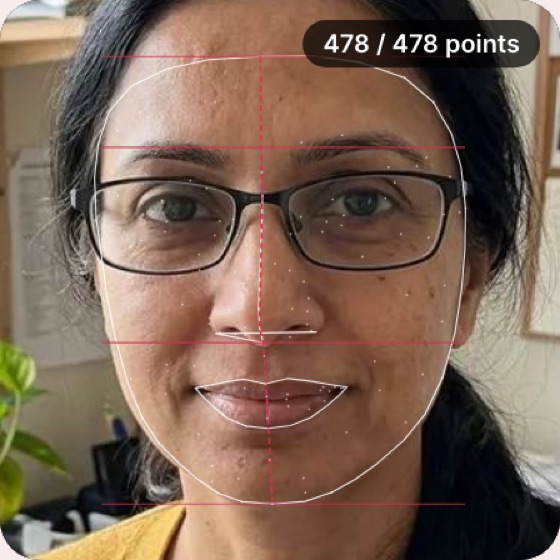
MediaPipe finds 478 points on your face in the browser, and our code turns them into six ratios. Once the model has loaded, the measurements take a few seconds.
- 3
Read your six rows
Each ratio shows your value, its ideal and a 0 to 100 bar. A written AI report with a 1 to 10 rating, feature notes and tips follows.
What this golden ratio calculator shows you
It shows its working instead of handing you a single number.
Six named ratios, not one mystery score
Mouth to nose, lower lip to upper lip, nose-to-chin, eyes to mouth, the rule of fifths and the facial thirds. Every row prints your value, so you can see which one pulls the average down.
A scoring rule you can check
Each ratio scores 100 at its ideal and drops 2 points for every 1 % it is off. The headline is the plain average of the six, with no hidden weights.
No guessing at your hairline
The landmark mesh stops just below the hairline. So we leave out face length to width and the forehead third instead of scoring a distance we can't see.
Measured and AI kept apart
Ratio panels carry a MEASURED label. Feature notes and tips sit in panels marked AI ESTIMATE, and the 1 to 10 rating is an AI opinion too. The AI is given your numbers and told to stay consistent with them.
The lines drawn on your photo
The overlay marks the facial midline plus four horizontal lines: top of the forehead, between the brows, the base of the nose and the chin. The lines sit on your photo's landmarks, while the numbers are computed after head pose is corrected, so on a turned head the two can differ a little.
The six golden ratio face measurements
Measured after head turn and tilt are corrected. Four ratios use phi; two use the classical canons.
| Measured between | Ideal | From | |
|---|---|---|---|
| Mouth width ÷ nose width | Mouth corners vs the outer edges of the nostrils | 1.618 | Phi |
| Lower lip ÷ upper lip | Height of each lip, measured from the line where they meet | 1.618 | Phi |
| Nose-to-chin ÷ lips-to-chin | Base of the nose to chin vs lip line to chin | 1.618 | Phi |
| Outer eye span ÷ mouth width | Outer eye corner to outer eye corner vs mouth corners | 1.618 | Phi |
| Face width ÷ eye width | Width at the cheekbones vs the average width of one eye | 5 | Rule of fifths |
| Middle third ÷ lower third | Brows to nose base vs nose base to chin, shorter over longer | 1 | Equal thirds |
What is the golden ratio of a face?
The golden ratio, phi, is about 1.618. Split a line so the whole divided by the longer part equals the longer part divided by the shorter, and that is the number you get. Euclid described it around 300 BCE as the extreme and mean ratio, later called the golden section. The name divine proportion comes from Luca Pacioli's 1509 book, illustrated by Leonardo da Vinci.
A golden ratio face is one where pairs of distances come close to 1.618. The modern version is surgeon Stephen Marquardt's phi mask from 2002, a grid of 1.618 relationships laid over a face. Two older artists' rules travel with it: a face is five eye widths across, and the brow line and nose base split its height into three equal bands.
How the golden ratio face score is calculated
Each ratio gets its own score: 100 at the ideal, minus 2 points for every 1 % your value is off, and 0 once it is 50 % off in either direction. A mouth 1.50 times as wide as the nose sits 7 % under 1.618, so that row scores 85. The headline match is the plain average of the six rows.
The headline is labeled Excellent from 90, Good from 75, Fair from 60 and Uneven below that. On our own 10 test selfies, covering different ages, genders and skin tones, the scores ran from 61 to 80. None reached 90. So treat Good as a strong result. Each row and the average are rounded to whole numbers, so even a 100 would not mean six exact matches.
Does a golden ratio face mean an attractive face?
Not reliably. Marquardt built his mask from faces already judged attractive, so it describes those faces rather than predicting beauty. In 2010, Pallett, Link and Lee tested proportions in Vision Research. People preferred eyes-to-mouth at about 36 % of face length and the distance between the pupils at about 46 % of face width. Neither is 1.618. A 2024 review by Naini in Maxillofacial Plastic and Reconstructive Surgery found no convincing evidence that phi defines facial beauty.
Other research points to symmetry, averageness, skin and expression instead. Read your score as a map of your proportions, which features run long or wide, and not as a grade.
Photo tips for an accurate golden ratio test
Four of the six ratios involve the mouth or nose, so small changes there move the score.
- Keep your lips closed and relaxed, because a smile widens the mouth and thins both lips.
- Hold the camera at eye level, since shooting from below stretches the lower third and shooting from above shrinks it.
- Use the back camera at arm's length or ask someone to shoot from about 3 feet away, because a close front camera makes the nose look wider.
- Face the lens straight on: the report warns when your head is turned more than 12 degrees sideways, 15 degrees up or down, or tilted more than 10.
- Let your face fill a good part of the frame, since a small face in a wide shot gets a warning and makes short distances like lip height less precise.
- Take off glasses whose frames cover the outer eye corners, because two of the ratios start there.
- Use soft light from the front, such as a window, so shadows don't hide the lip line or the nostril edges.
Golden ratio face mistakes to avoid
Mistake: Treating 100 as the goal.
Do this instead: Look at your lowest row and what it says about your proportions. Our test faces scored 61 to 80, and because scores are rounded, even a 100 would not mean six exact matches.
Mistake: Comparing two scores from photos taken differently.
Do this instead: Lens distance, angle and expression all shift the ratios. Compare only photos shot with the same camera, distance and neutral face.
Mistake: Measuring face length ÷ width with a tape and calling it your golden ratio.
Do this instead: That number depends on where you decide the hairline is. Ratios between features with clear edges, like the six above, are easier to repeat.
Mistake: Uploading a filtered or face-slimming photo.
Do this instead: Beauty filters move the very points being measured. Use an unedited photo straight from the camera.
Mistake: Reading the percentage as how attractive you are.
Do this instead: It measures distance from 1.618 and two classical canons. For an opinion on looks, read the AI rating, which is a separate and labeled estimate.
What's free, where your photo goes, and the limits
Free, no sign-up
Every visitor gets five free reports a day with no account to create. A report that breaks on our side is not counted; a photo the AI rejects as unusable is. Past that, leaving an email gets you 20 more that day.
Your photo
The landmarks are found in your browser. The shrunk photo and the measurements are then sent once, in a single request, to the AI provider that writes the report. This site does not save your photo: it is sent once to the AI for your report and then discarded, and we never use it to train models.
What it can't tell you
It measures a flat photo, not bone structure, so lens and angle matter. It is not a medical or surgical assessment, and the site is for adults 18 and over.