
Attractiveness Test
An attractiveness test that shows its work: geometry measured from 478 landmarks, an AI rating out of 10, and labeled panels that say which is which.
- Free, no sign-up
- 478 face landmarks measured
- Photo never stored
Upload your photo to get your report
Front-facing selfie, good lighting. JPG, PNG, WebP or HEIC. Drag & drop or paste (Ctrl+V).
Take the testMeasured on your device. The photo is sent once to the AI for the report; this site never saves it.
Good photo checklist
- Face the camera straight on, with the phone at eye level
- Even, soft light from the front; no strong shadows
- Neutral expression, hair off the face, no sunglasses or filters
- Hold the phone at arm's length or further: close-up selfies stretch the nose and shrink the jaw
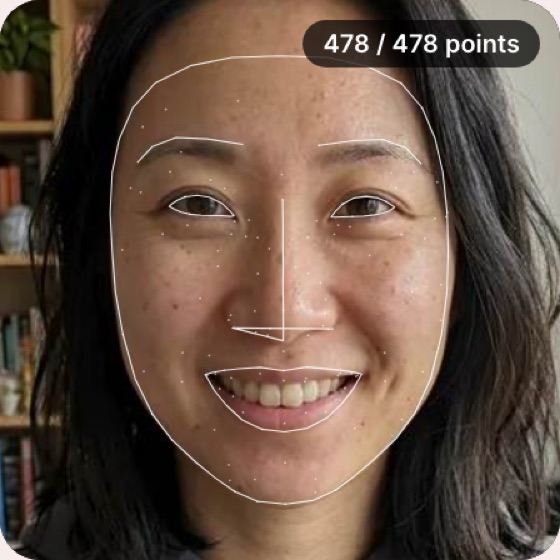
How the AI attractiveness test works
Two separate steps: geometry measured in your browser, then an AI review that reads the photo and those numbers together.
- 1
Upload one selfie
JPG, PNG, WebP or HEIC. Your browser converts HEIC and shrinks the photo to 1024 px on the long side before anything else happens.
- 2
Your browser measures the face
Google's open-source MediaPipe model places 478 landmarks, and our code turns them into symmetry, golden ratio match, face shape and eye shape. Once the model has loaded, this takes about three seconds.
- 3
The AI writes the report
The photo and the measurements go once to Google Gemini, which returns a rating from 1.0 to 10.0, a potential score, eight feature scores, strengths and three tips.
An attractiveness test that says what it measured
A lone number is hard to trust. This attractiveness test tells you where each number came from.
MEASURED or AI ESTIMATE on every panel
Symmetry, golden ratio, face shape and eye shape are geometry from landmarks. The overall rating, skin, hair and feature notes are the AI's opinion. Each breakdown panel is labeled, so the two don't get mixed up.
Head angle corrected before scoring
Turn and nod are undone before symmetry is computed, and tilt is handled by measuring along your own facial midline. If the head is turned too far, the report says so instead of quietly marking you down.
A rating and a potential
Next to the rating you get a potential score: the AI's estimate for the same face with better grooming and a better photo. Treat the gap as a hint, not a measurement.
The biggest drag, named
The feature the AI sees as holding your rating back is shown beside the landmark mesh, with one concrete fix. If the AI names none, the lowest-scored of the eight features takes its place.
What makes a face attractive, and what the test checks
Research links a handful of traits to higher attractiveness ratings. Here is how this attractiveness test treats each one.
| What research found | In this test | |
|---|---|---|
| Symmetry | Linked to higher ratings in reviews of the field (Rhodes, 2006) | Measured: 0 to 100, plus eyes, brows, nose, mouth and jaw |
| Averageness | Faces close to a population average are rated higher | Not scored: we hold no population average to compare you with |
| Proportions | Balanced thirds and spacing help; the golden ratio has weaker support | Measured: golden ratio match 0 to 100 from six ratios |
| Skin | Healthy-looking skin is linked to higher ratings (Rhodes, 2006) | AI estimate: one of the eight feature scores |
| Eyes, jaw, cheekbones | Feature shape and sex-typical traits shift ratings | AI estimate, with eye shape and canthal tilt measured |
| Expression and grooming | A relaxed face and tidy grooming lift ratings of the same person | AI estimate: reflected in the potential score and the tips |
| Voice, movement, personality | Change how attractive people seem in person | Not visible in a photo, so not scored |
What the science says about how attractive you are
Two findings hold up across decades of studies. Faces averaged from many photos are rated more attractive than most of the faces that went into them (Langlois and Roggman, 1990). Reviews of the field also point to symmetry, sex-typical features and healthy-looking skin (Rhodes, 2006).
People agree on these broad cues more than you might expect, within and across cultures. They agree far less on individual faces: personal taste, shaped by the faces someone grew up around, decides much of who finds whom attractive.
So an attractiveness test can describe the shared cues in one photo. It cannot tell you whether a particular person will be drawn to you.
Before you take the attractiveness test
The first four tips match warnings the attractiveness test can raise. The last two are yours to check, because no warning catches them.
- Face the camera straight on: the report flags a head turned more than 12 degrees or tipped up or down more than 15.
- Keep your head level, since a tilt of more than 10 degrees also triggers a warning.
- Fill a good part of the frame with your face; a small face in a wide shot gets flagged as too small to measure well.
- Be the only person in the shot, because with two faces the largest one is measured.
- Pull hair back from the brows and jawline so the landmarks on the face outline can be found.
- Use soft light from the front and skip beauty filters, which smooth the skin the AI is asked to judge.
Reading your attractiveness scale result the wrong way
Mistake: Treating the 1 to 10 rating as a measurement.
Do this instead: It is an AI opinion, not geometry. The measured numbers are symmetry, golden ratio, face shape and eye shape, in the panels labeled MEASURED.
Mistake: Comparing your number with a score from another app.
Do this instead: Scales differ: some run 0 to 100, some 1 to 10, some on PSL. Compare two of your own photos here instead.
Mistake: Expecting a 10 from a good face.
Do this instead: The AI is told most people land between 5.0 and 7.5 and that 8.5 or above is rare. A 6.5 is a solid result.
Mistake: Reading 'not scored' as 'doesn't matter'.
Do this instead: Averageness, voice and how you move all count in real life. The test leaves them out because one photo can't show them.
Mistake: Letting one photo decide.
Do this instead: Test two or three photos in different light and trust the measured numbers that stay close. The rating can move a few tenths between runs even on one photo, so a small change may be the photo, AI variation or both.
Mistake: Ignoring a photo warning and trusting the number anyway.
Do this instead: Retake the shot. A turned head can make one eye look higher than it is.
A free attractiveness test, honest about its limits
What's free
Five free reports a day, no account. Past that, an email gets you 20 more that day. A report that breaks on our side is not counted, but a photo the AI rejects as unusable is. Reports are 5 seconds apart.
What happens to your photo
This site does not save your photo: it is sent once to the AI for your report and then discarded, and we never use it to train models. It is sent once to the AI provider, together with your measurements, inside the request that writes your report.
What runs on your device
The landmark model is downloaded to your browser and the measurements are computed there. Only the report step uses a server.
What it is not
Not a clinical or scientific assessment, not a percentile, and not for children: the site is for adults 18 and over.