
Face Symmetry Test
A face symmetry test that undoes head turn, scores your eyes, brows, nose, mouth and jaw, and names the side that sits higher. Free, no sign-up.
- Free, no sign-up
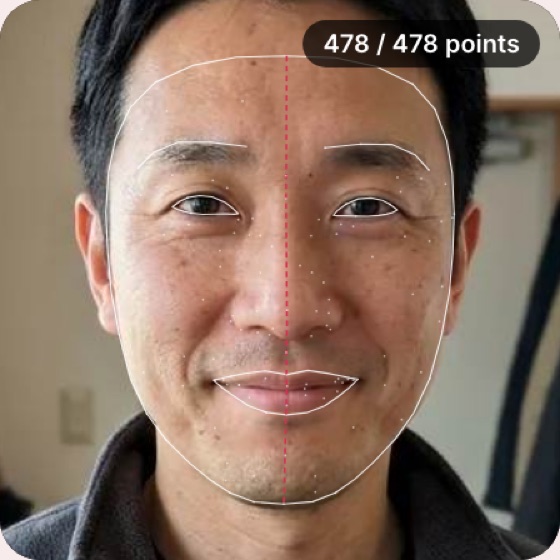
- 478 face landmarks measured
- Photo never stored
Upload your photo to get your report
Front-facing selfie, good lighting. JPG, PNG, WebP or HEIC. Drag & drop or paste (Ctrl+V).
Test my symmetryMeasured on your device. The photo is sent once to the AI for the report; this site never saves it.
Good photo checklist
- Face the camera straight on, with the phone at eye level
- Even, soft light from the front; no strong shadows
- Neutral expression, hair off the face, no sunglasses or filters
- Hold the phone at arm's length or further: close-up selfies stretch the nose and shrink the jaw
How the face symmetry test works
Three steps; the measuring part of this face symmetry test happens on your own device.
- 1
Upload one straight-on photo
JPG, PNG, WebP or HEIC. Look into the lens with a relaxed face; the browser shrinks the photo before anything else happens.
- 2
Your device maps and mirrors the face
MediaPipe places 478 landmarks, our code fits a midline and mirrors 22 left and right point pairs across it. Once the face model has loaded, this takes about 3 seconds.
- 3
Read the five regions, then the AI notes
You get an overall score, a bar per region, a dashed midline on your photo and a line naming the higher eye, brow or mouth corner, or the wider jaw side. The AI report follows.
What this face symmetry checker measures differently
Head turn is undone first
The 3D mesh is rotated back to a frontal view, removing yaw and pitch before any point is mirrored. A slightly turned head counts far less against you, though a straight-on photo still reads best.
Tilt is accounted for
Every distance is taken along and across your own fitted midline, not the photo's edges, so a head tilted to one side is measured in its own frame.
Five region scores
Eyes (4 point pairs), brows (3), nose (2), mouth (3) and jaw (4) are scored on their own, so you see which part carries the difference.
It names the side
The higher eye is named once the gap passes 1.5% of face width, a brow or mouth corner past 2%, the wider jaw side past 3%. Below that it says no side stands out.
Measured, then estimated
Symmetry panels carry a MEASURED label because they are pure geometry. The AI's feature notes sit in panels marked AI ESTIMATE, and the AI is told to stay consistent with the numbers.
Three ways to check if your face is symmetrical
The mirror-half photo trick, other online checkers and this test, side by side.
| This test | Mirror-half photo trick | Other online checkers | |
|---|---|---|---|
| Head turn | Yaw and pitch undone in 3D | Turn shows up as asymmetry | Varies by tool |
| Where the midline sits | Fitted through 7 center points | Wherever you cut the photo | Varies by tool |
| Per-region result | Eyes, brows, nose, mouth, jaw | Visual only | Depends on the tool |
| Which side is higher | Named, with a threshold | You judge by eye | Varies by tool |
| What the score means | Mismatch as % of face width | No score | Depends on the tool |
| Cost | five free reports a day, no sign-up | Free, needs a photo editor | Varies by tool |
What a good face symmetry score is
The score comes from one formula: 100 x (1 - average mismatch / 12% of face width). For each pair, one point is reflected across the midline and we measure how far it lands from its partner, both sideways and in height. Face width runs cheek to cheek.
So 90 means mirrored points miss their partners by 1.2% of face width on average, 75 means 3%, 50 means 6%, and the score hits 0 at 12% or more. The report labels 90 and up Excellent, 75 to 89 Good, 60 to 74 Fair and below 60 Uneven.
On our 10 test selfies the face symmetry test scored between 79 and 97. None reached 100. Scores are rounded to whole numbers, so a displayed 100 would mean an average miss under about 0.06% of face width, not a perfect match. These labels describe one photo, not a rank against other people.
Photo checklist for a fair face symmetry score
- Hold the phone at eye level and look straight into the lens.
- Use the rear camera at arm's length or more; a close front camera enlarges the side nearer the lens.
- Keep a neutral mouth, since even a faint half-smile lifts one corner.
- Face a window or lamp so light falls evenly on both cheeks.
- Push hair off your brows and jawline, and take off glasses.
- Let your face fill a good part of the frame so the landmarks have detail to work with; a very small face gets a warning.
- Be the only face in the shot, or the largest one is measured.
Mistakes that skew a symmetrical face reading
Mistake: Reading the side notes off a mirrored selfie
Do this instead: Some phones save front-camera shots flipped. The score should not change, but left and right swap, so check the photo isn't mirrored before trusting which side is higher.
Mistake: Smiling or raising one brow
Do this instead: Expression moves the mouth and brow pairs most. Retake with a relaxed face.
Mistake: Trusting one photo
Do this instead: Run the face symmetry test on two or three shots. A difference that shows on all of them is likely your face; one that comes and goes is more likely pose, light or expression.
Mistake: Comparing photos taken under different conditions
Do this instead: To track a change, repeat the same camera, distance, light and expression.
Mistake: Ignoring the head-turn warning
Do this instead: Past 12 degrees of turn or 15 of up-and-down tilt the correction has less to work with. Face the lens and retake.
What happens to your photo, and the limits
Measured here, not saved here
The landmarks and symmetry numbers are computed in your browser. The shrunk photo and those numbers are then sent once to the AI model (Google Gemini, through KIE) for the written report. This site does not save your photo: it is sent once to the AI for your report and then discarded, and we never use it to train models. What the provider keeps is covered by its own terms.
What's free
Each visitor gets five free reports a day with no sign-up and no account. A report that breaks on our side is not counted; a photo the AI rejects as unusable is. Past that, leaving an email gets you 20 more that day.
Not a medical test
This face symmetry test is geometry from one photo, with no clinical validation behind it. It cannot tell anatomy from lens or lighting, and it diagnoses nothing.