
What Eye Shape Do I Have
Upload a selfie to answer what eye shape do I have: openness, corner tilt and spacing measured, eyelid type read by AI. five free reports a day, no sign-up.
- Free, no sign-up
- 478 face landmarks measured
- Photo never stored
Upload your photo to get your report
Front-facing selfie, good lighting. JPG, PNG, WebP or HEIC. Drag & drop or paste (Ctrl+V).
Find my eye shapeMeasured on your device. The photo is sent once to the AI for the report; this site never saves it.
Good photo checklist
- Face the camera straight on, with the phone at eye level
- Even, soft light from the front; no strong shadows
- Neutral expression, hair off the face, no sunglasses or filters
- Hold the phone at arm's length or further: close-up selfies stretch the nose and shrink the jaw
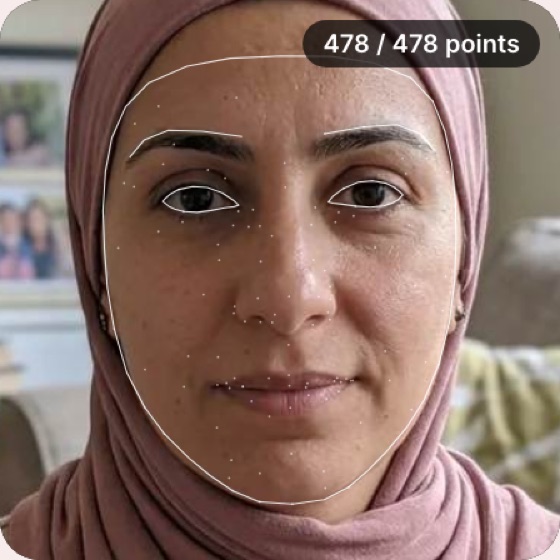
How the eye shape analyzer reads your photo
Three numbers come from geometry on your device; the eyelid needs eyes, so the AI looks at that.
- 1
Upload a straight-on selfie
JPG, PNG, WebP or HEIC. Your browser converts HEIC and shrinks the photo to 1024 px on its long side.
- 2
Your device measures both eyes
MediaPipe places 478 landmarks, then our code levels the face and reads openness, corner tilt and eye spacing from the corners and lid edges. This takes about 3 seconds once the model has loaded.
- 3
The AI reads your eyelid
The shrunk photo and the numbers go to Google Gemini once. It names your lid type (double, monolid, hooded, deep-set or protruding) and adds three practical tips.
Why three readings beat one eye shape label
The honest reply to what eye shape do I have is three answers, plus a fourth about the lid.
Shape, tilt and spacing stay separate
You get one word on each scale, such as almond, upturned and balanced, instead of being forced into one of six boxes. An eye can be a mix, and the result shows it.
The cut-offs are published
The shape, tilt and spacing labels each come from a number you can see under the panel, and the thresholds are written out below. Eyelid type is the one label the AI gives instead.
Eyelid type comes from the AI, not the mesh
Landmarks mark the lid edge, not the crease, so geometry cannot tell hooded from monolid. That call comes from the AI looking at your photo, so treat it as an estimate.
A tilted head does not flip your tilt
We rotated three test selfies 8 degrees each way. The corner tilt reading moved by 0.9 degrees at most, and no label changed.
Ways to find your eye shape, side by side
The mirror test and picture quizzes are free too. Here is what each one can and cannot tell you.
| Mirror test | Picture quiz | Geometry-only scanner | This page | |
|---|---|---|---|---|
| Corner tilt | By eye, against a line | Pick the closest drawing | Varies by tool | Degrees, cut-offs shown |
| Round vs almond | Look for white above or below the iris | Pick a drawing | Ratio | Height ÷ width ratio |
| Eye spacing | Compare the gap to one eye | Depends on the quiz | Ratio | Gap ÷ eye width ratio |
| Hooded or monolid | Yes, if you know what to look for | Yes, self-reported | Varies by tool | AI reads it from the photo |
| Head tilt and angle | Easy to get wrong | Not a factor | Varies by tool | Face levelled, warning past 10° |
| Cost | Free | Free | Varies by tool | five free reports a day |
What your eye shape changes in makeup and glasses
Each reading points at a different decision, so read the one that matters for the job.
Eyeliner wing angle (tilt)
Upturned eyes already lift, so a flatter wing keeps them balanced. Downturned eyes take a wing that starts rising from about two thirds along the lid and skips the lower outer corner.
False lashes and extensions (openness)
Round eyes gain length from longer lashes at the outer corner. Narrow eyes look more open with the longest lashes over the center of the lid.
Eyeshadow on hooded or monolid lids (eyelid)
On a hooded lid, place crease color a little above the natural crease so it shows with the eye open. On a monolid, a graphic liner or color across the whole lid stays visible.
Glasses bridge and frame (spacing)
Close-set eyes look further apart with a light or clear bridge. Wide-set eyes come together under a darker, heavier bridge.
Lash artists and makeup artists
Ask a client for a straight-on selfie before the appointment and plan the lash map or liner from the three readings instead of a guess in chair lighting.
Where the almond, round and narrow lines sit
Openness is the height of the open eye divided by its width, averaged over both eyes. Under 0.24 reads narrow, over 0.36 reads round, and almond is everything between.
Corner tilt is the angle from the inner to the outer corner. Under 2 degrees reads downturned, over 8 degrees upturned, and neutral in between. These lines sit higher than the plus or minus 5 degrees you see in charts. The landmark mesh reads corners about 4 degrees more upturned, and eyes about 25 percent narrower, than a ruler on a photo.
Spacing is the gap between the inner corners divided by one eye width: under 1.15 close-set, over 1.5 wide-set, balanced between.
What our own test selfies showed
We ran the analyzer on the 10 test selfies we use across this site. All 10 read almond, with openness between 0.26 and 0.33. Corner tilt ran from 3.9 to 10.0 degrees: one face read upturned, the rest neutral. Spacing put one face wide-set at 1.63 and the other nine balanced.
If you ask what eye shape do I have, you may expect one striking word. The lesson from our runs: almond is a wide middle band, and all ten of our test faces landed in it. Ten faces say nothing about how common each shape is. If your result says almond, neutral and balanced, the raw numbers tell you which way you lean.
Before you upload, for a clean eye reading
- Hold the camera at eye level; looking down at the phone lowers the upper lid and makes eyes read narrower.
- Keep a relaxed face, because a smile pushes the lower lid up and closes the eye.
- Take glasses off so the frame does not hide the outer corners.
- Skip heavy winged liner and false lashes, which redraw the outline the landmarks follow.
- Face a window or soft light so both inner corners are visible, not lost in shadow.
- Look straight into the lens with both eyes fully open.
Mistakes when you work out your eye shape
Mistake: Judging tilt in the mirror with your head slightly tipped.
Do this instead: Compare each outer corner with its own inner corner, not with the edge of the mirror.
Mistake: Reading your eyes from a smiling photo.
Do this instead: Use a neutral face. Smiling can turn an almond eye narrow.
Mistake: Calling hooded an eye shape.
Do this instead: Hooding is a lid type that sits on top of any shape, so an eye can be hooded, almond and upturned at once.
Mistake: Checking a landmark tilt against a chart that says 5 degrees.
Do this instead: Charts assume a ruler on a photo. Use the cut-offs of the tool that took the measurement.
Mistake: Assuming both eyes match.
Do this instead: Small differences between the left and right eye are normal; the reading averages the two.
Free eye shape reports, your photo and the limits
five free reports a day, no sign-up
Each visitor gets five free reports a day with nothing to register. A report that breaks on our side does not count; a photo the AI rejects as unusable does. Past that, leaving an email gets you 20 more that day.
Your photo
This site does not save your photo: it is sent once to the AI for your report and then discarded, and we never use it to train models. The measurements are made in your browser; then the shrunk photo and those numbers go once to the AI provider, inside the request, for the eyelid read and tips.
What it does not do
It does not read eye color, and it is not an eye exam. A lid that has started to droop over the pupil is a question for a doctor. The site is for adults 18 and over.